

 center top;

There's nothing wrong with buying a tie based on appearance alone. But if you dig past the surface, there's a smarter purchase and better quality tie that lies underneath.
Taking a few moments to look at the tie's construction can reveal a lot about the quality of a necktie. The good news is that you don't need to be a skilled tailor to know the basics of tie construction.
Knowing more about tie construction will make you a more informed buyer ensuring that you purchase ties which are not only beautiful but are built to last.
Let's break down the main elements of a tie. We'll tell you about what to look for the next time you shop for a tie.
Where the Tie Came From
The modern necktie's history dates to the 17th century and the court of Louis XIV. The story goes that the neckwear of Croatian soldiers caught the Sun King's eye, and he adopted it as an everyday piece.
That predecessor, the "cravat", was a wide piece of fabric worn around the neck and tucked inside an open-necked shirt. The French word for necktie is still cravate.
Between the mid-17th and 19th centuries the cravat marked class and status, and it was worn as an expression of personal style rather than as an indicator of profession. That changed in 1864, when the first mass-produced ties reached the industrial world. Ties became associated with middle and upper-class white-collar work, and through most of the twentieth century they were synonymous with business, finance and politics.
Two things survived all of it. The first is the reason the tie exists at all: the suit's lapels and the shirt collar frame the neck, and something has to sit inside that frame. The second is how one is made. The construction described below has barely changed in a hundred years.
Do men still wear ties?
Fewer than they did, and more in law and accounting than in tech. But the tie never depended on being compulsory. It is worn now for the reason the cravat was worn in the first place, which is to say something about the man rather than about his job. As long as suits are built the way they are built, there is a place for it.
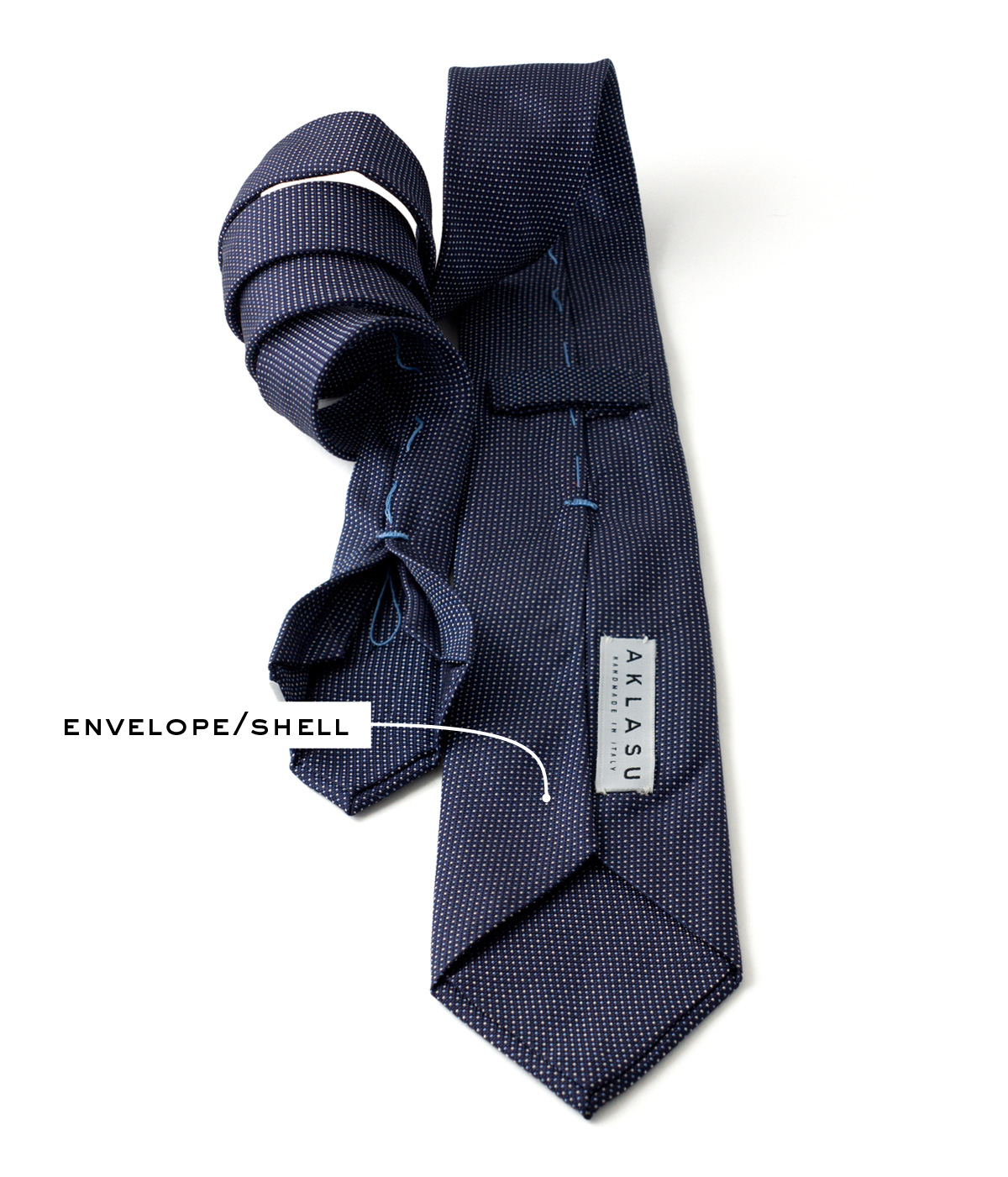
Envelope/Shell: Cut on a True Bias
The envelope is the shell of the tie. It can be made from just about any fabric or material. The most common quality fibres are silk, linen, wool and cotton. You can also find some envelopes that are a blend of those fabrics, e.g. silk and wool.
A good quality tie is made of an envelope that was cut on the true bias, which is at 45 degrees from the finished edge of the fabric. The tie won't hang straight or achieve its true elasticity if the envelope is not cut in this manner. The tie won't endure everyday use, and as a result, it will become permanently deformed.
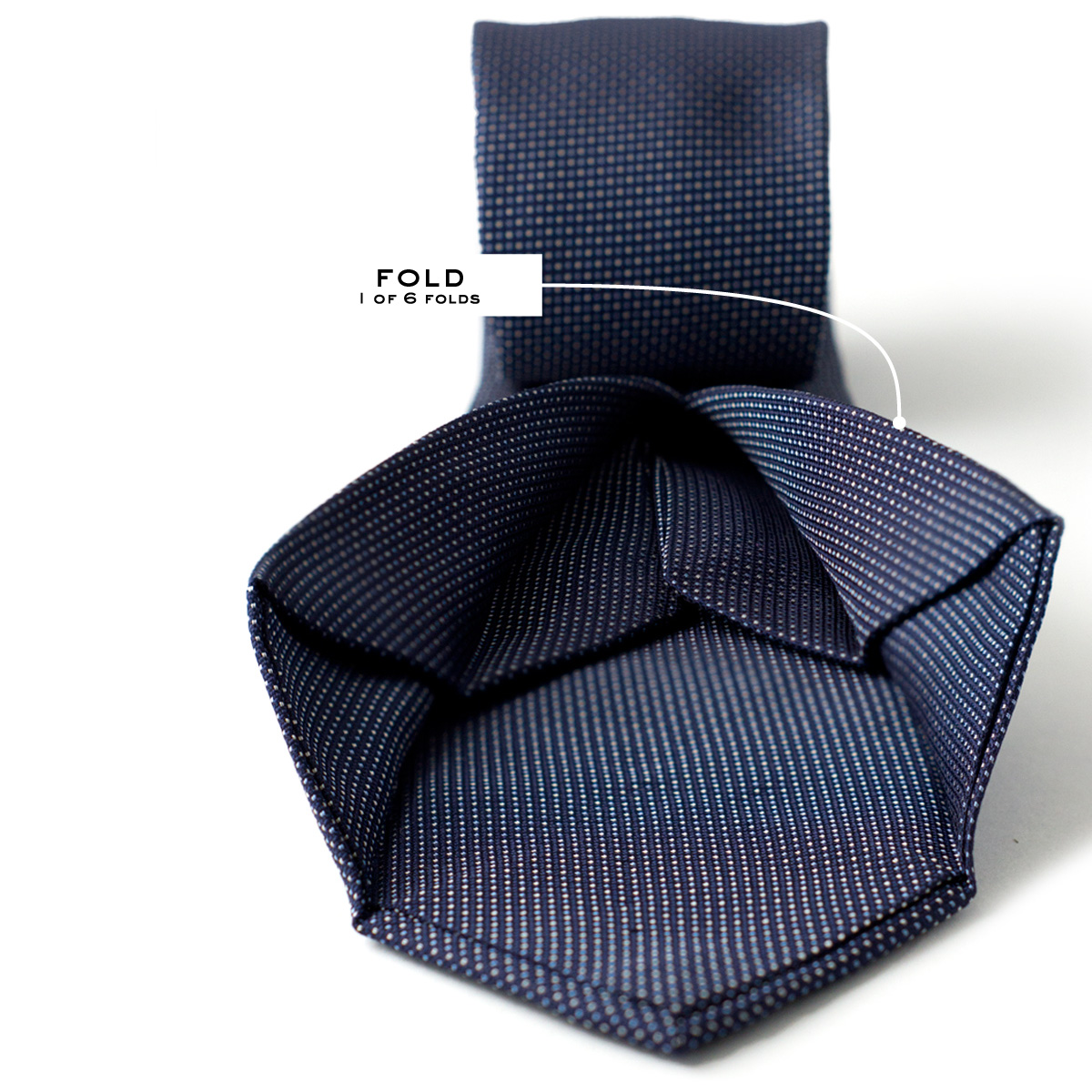
Folds: More is Not Necessarily Merrier
Ties are made by folding fabric. The image shows a Six-Fold tie, produced from a single piece of silk fabric folded six times during construction. Aklasu made six-fold ties for several years, and we retired the construction in 2026. You can still read about the six-fold ties we used to make.
Contemporary ties are folded three times. More folds equal more fabric which in turn lends greater weight to the tie, improved drape, and superior knots.
A Note on Folds
The more, the better? We don't think so. It all depends on what you're looking for. Contemporary 3-Fold ties (Aklasu's standard) can be equally as good as a Six or Seven-Fold tie.
Ultimately, construction and quality raw materials are the deciding factors. Seven and more fold ties are typically made with no lining due to the vast amount of fabric used. Although they are beautiful artisan pieces, they tend to be too heavy and retain wrinkles due to the lack of lining.
Interlining: Wool Won't Let You Down
The interlining is a piece of fabric, typically wool, that is hidden within the envelope of the tie. The interlining helps give a tie its shape and provide wrinkle resistance. The interlining of a quality tie is constructed with wool since it is wrinkle-resistant, soft and durable. Some manufacturers use cotton or synthetics which are inferior to wool.

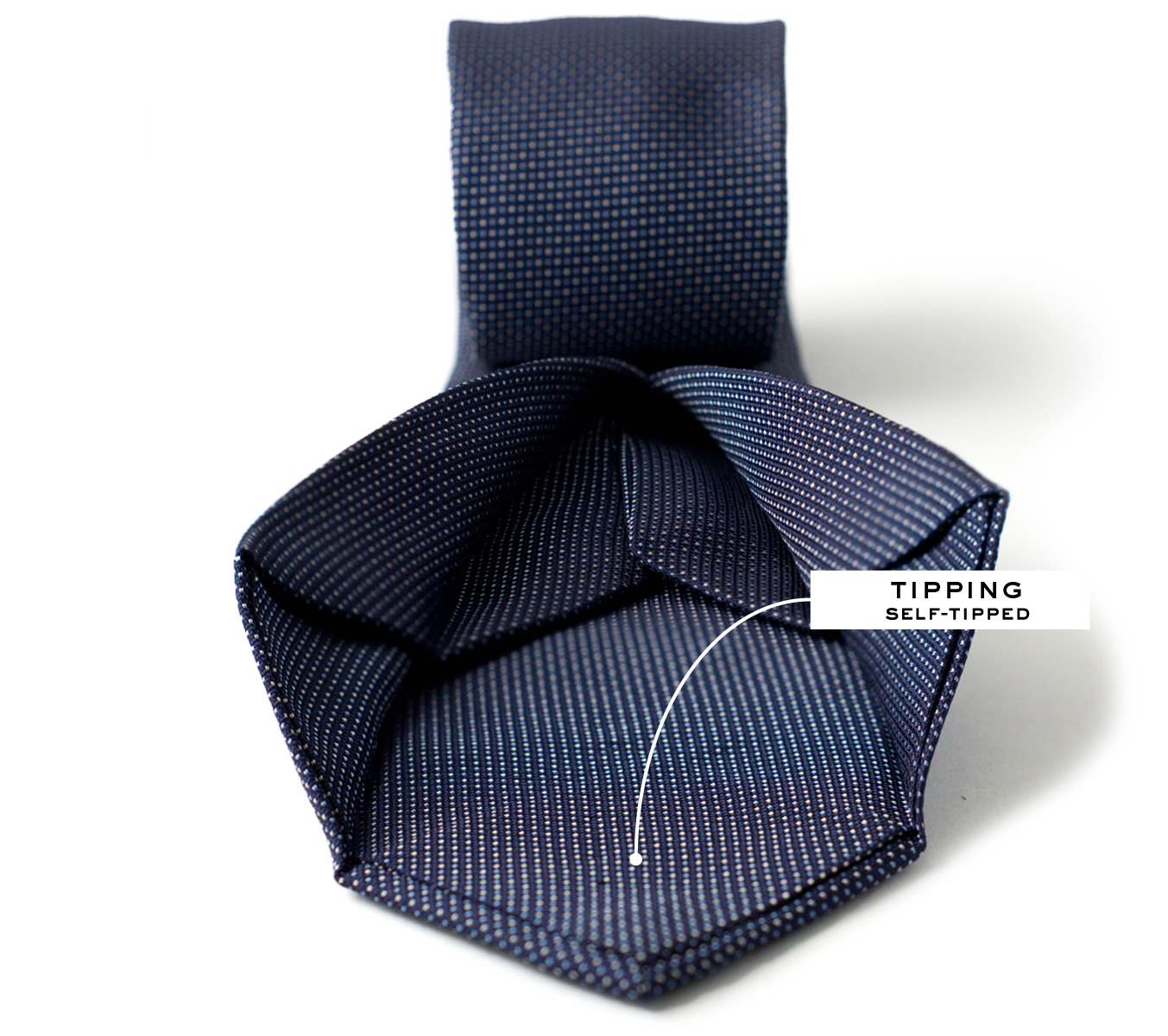
Tipping: Self-Tipped Says A Lot
'Tipping' is the material used to finish the reverse side of the tie. Many manufacturers make the tipping with a different, contrasting material than that used for the body or 'envelope' of the tie. If a more inferior fabric is used for the tip, you may want to question the quality of your tie. This approach can at times be a cost-cutting measure.
A self-tipped tie means that the tipping is of the same, high-quality silk as the envelope. A quality tie is likely to be self-tipped but not always.
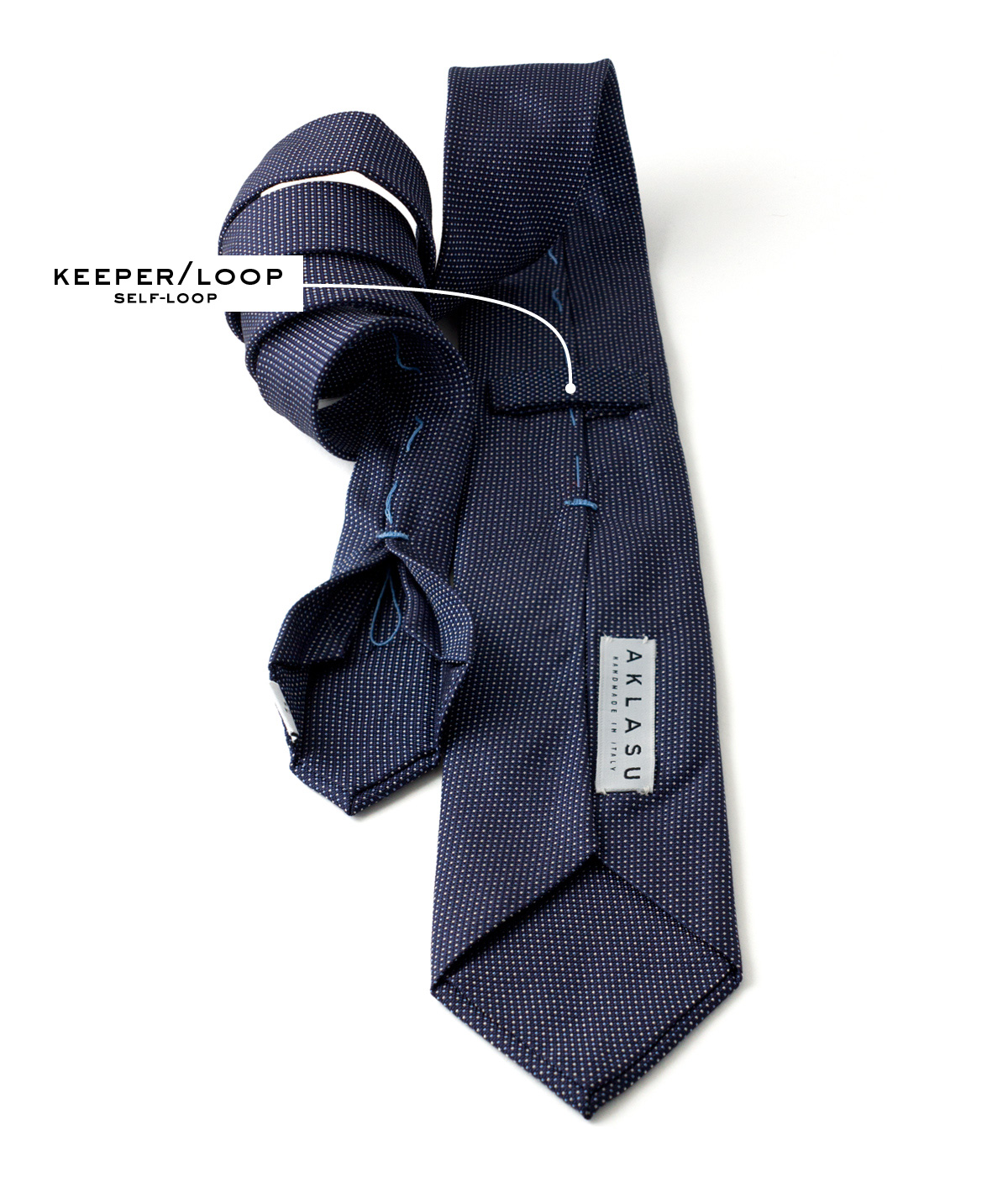
Loop/Keeper: More Than a Brand Label
The 'loop' or 'keeper' is the band of material on the reverse of the envelope that secures the back blade or 'tail' of the tie. Many manufacturers use brand labels as keepers, but these keepers often fail to withstand the stresses and strains of everyday wear.
As the most functional element of the tie, the keeper must be of a quality material that is well-secured to the envelope. When the manufacturer makes the keeper of the same high-quality material as the envelope (Self-Loop), it's a good sign the manufacturer wasn't taking any shortcuts.
Take a few moments to examine your next tie purchase. It likely looks great, but give yourself peace of mind that the book is as good as the cover.
Once you know how a tie is built, the next question is what it is built from. We have written that one out in full: the best material for a tie. For the weave that makes a grenadine behave differently from flat silk, see what a grenadine tie is.

Navy Grenadine Tie
Handmade in Como, Italy
Which length?
- 6′ and under
- Standard
- Over 6′
- Extra Long
Details & Care
- Solid
- Grenadine Fina
- 100% Silk from Como, Italy
- Three-Fold
- Dry Clean Only
- Handmade in Italy
Learn why Grenadines are the best-kept secret in menswear and why you should wear them.
Delivery & Returns
Delivers in 3–5 business days.
Free delivery to the United States on orders over $135 USD, or $20 USD flat rate below that.
Free returns and exchanges. See our return policy.
Client Service
Hours
Monday to Friday, 9am – 5pm MST
Closed weekends and statutory holidays
Reach us
1 800 595 0276
office@aklasu.co

Burgundy Grenadine Tie
Handmade in Como, Italy
Details & Care
- Solid
- Grenadine Fina
- 100% Silk from Como, Italy
- Three-Fold
- Dry Clean Only
- Handmade in Italy
Learn why Grenadines are the best-kept secret in menswear and why you should wear them.
Delivery & Returns
Delivers in 3–5 business days.
Free delivery to the United States on orders over $135 USD, or $20 USD flat rate below that.
Free returns and exchanges. See our return policy.
Client Service
Hours
Monday to Friday, 9am – 5pm MST
Closed weekends and statutory holidays
Reach us
1 800 595 0276
office@aklasu.co

Forest Green Grenadine Tie
Handmade in Como, Italy
Which length?
- 6′ and under
- Standard
- Over 6′
- Extra Long
Details & Care
- Solid
- Grenadine Fina
- 100% Silk from Como, Italy
- Three-Fold
- Dry Clean Only
- Handmade in Italy
Learn why Grenadines are the best-kept secret in menswear and why you should wear them.
Delivery & Returns
Delivers in 3–5 business days.
Free delivery to the United States on orders over $135 USD, or $20 USD flat rate below that.
Free returns and exchanges. See our return policy.
Client Service
Hours
Monday to Friday, 9am – 5pm MST
Closed weekends and statutory holidays
Reach us
1 800 595 0276
office@aklasu.co

Set for Life™ - Essential Grenadine Tie Collection
Details & Care
- Solid
- Grenadine Fina
- 100% Silk from Como, Italy
- Three-Fold
- Dry Clean Only
- Handmade in Italy
Delivery & Returns
Delivers in 3–5 business days.
Free delivery to the United States on orders over $135 USD, or $20 USD flat rate below that.
Free returns and exchanges. See our return policy.
Client Service
Hours
Monday to Friday, 9am – 5pm MST
Closed weekends and statutory holidays
Reach us
1 800 595 0276
office@aklasu.co


